Initiated by the INGO Accountability Charter · Funded by the Rockefeller Foundation and the Feedback Labs Collaboration Fund
What does accountability look like when we workwithpeople, not just for them?
Digital connectivity was changing what people expected from organisations. Stakeholders no longer wanted to be passive recipients of expert-led work — they wanted to actively contribute, co-shape outcomes, and move fluidly in and out of issues they cared about.
Leading CSOs were already responding with people-powered strategies, placing co-creation and mass stakeholder engagement at the centre of their work. But their accountability practices had not kept pace. Most frameworks were still designed for organisations that deliver to beneficiaries, not ones that invite thousands of people to co-shape campaigns and decisions.
This project set out to change that.
How We Worked
1
Amsterdam kick-off · May 2015
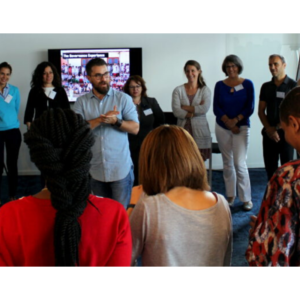
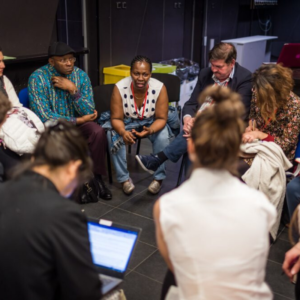
A workshop at Greenpeace Netherlands brought together 21 representatives from Charter Member organisations to explore the opportunities and challenges of digital accountability. Keynote speaker Lauren Woodman (NetHope) set the frame on real-time stakeholder engagement.
2
Core and Reference Groups · 2015 - 2016
A Core Group of eight thought leaders formed, supported by a Reference Group of 18 additional experts. Together they worked through virtual exchanges, webinars, and six organisational case studies examining how leading CSOs were already navigating people-powered accountability.
3
Bellagio Centre, Italy · Early 2016
The project culminated at the Rockefeller Foundation’s Bellagio Centre, where the Core and Reference Groups synthesised their findings into six key principles of a new accountability paradigm.
The Six Principles
Developed at the Bellagio Centre, March 2016
01
Ask stakeholders how to add strategic value
Radical clarity on the value you add in an environment where support of active people and groups should be at the forefront of CSO work.
02
Share power, share responsibility
Define clearly what is and is not people-led. Give people genuine agency within an agreed space while maintaining overall organisational integrity.
03
Open your books
Move beyond annual reporting toward in-time, on-demand transparency that enables genuine co-creation and stakeholder participation.
04
Move from quantity to quality relationships
Focus on increasing the quality of empowering relationships to people and partners and using that as a success indicator in and of itself.
05
Evaluate success collectively
Identifying, monitoring and evaluating impact should be a shared process driven by ongoing stakeholder feedback, not periodic donor reporting cycles.
06
Attune risk-taking and ownership
Let go of control where doing so enables greater stakeholder engagement. Protect the organisational core where it matters most.
Featured output
Digital Accountability: Empowered Relationships — Leveraged Impact
The outcome report from the Bellagio meeting. Sets out the six principles of the new accountability paradigm with detailed case studies and practical examples drawn from the work of the Core and Reference Groups — including examples from Amnesty International, Greenpeace, Transparency International, 350.org, 38 Degrees, and others.
The primary output of the Bellagio meeting. Sets out the six principles with detailed case studies and practical examples from Amnesty International, Greenpeace, Transparency International, 350.org, 38 Degrees, and others.
A structured diagnostic asking how good your organisation is at connecting and co-creating impact in the digital age while acting responsibly. Eight questions covering culture, strategy, impact assessment, risk, stakeholder relationships, and organisational structures, each with sub-questions across governance, leadership, finance, HR, and operations.
Practical one-pagers for six organisational roles: Board Member, Strategy Director, CEO, COO, Campaign/Programme Director, and HR Director. Each guide spells out what people-powered accountability looks like from that role’s perspective, with links to real-world examples.
Documents the kick-off workshop at Greenpeace Netherlands in Amsterdam, where 21 Charter Member representatives explored the opportunities and challenges of digital accountability. Includes insights from keynote speaker Lauren Woodman (CEO, NetHope).
A public webinar featuring Karenina Schröder (INGO Accountability Charter) and Maro Pantazidou (Amnesty International) on what digital accountability looks like in practice for large international CSOs.