


Across the globe, CSO accountability practitioners are grappling with the same questions: Are we doing enough to protect our stakeholders and organizations? What is the right way for organizations to rightsize their safeguards? What is good enough? And how do we ensure that the systems we put in place are salient enough to grow, change and adapt with our organizations?
In May we convened a Dynamic Accountability Dialogue to dive into Right Sizing Safeguards. The conversation explored how organizations of different sizes can implement safeguarding policies that are practical, context-specific, and genuinely effective. And participants emphasized the need for safeguarding to be more than just box-ticking compliance exercises.
An overarching theme emerged: one size never fits all. Safeguarding systems must be designed for the specific context of the organization, which includes its size, geography, thematic area, and more. Safeguarding only works when it is internalized as organizational culture, owned by frontline staff, and built from the ground up with the people it is meant to protect. Read on to learn more takeaways from the Dialogue.
Staff turn to leadership for understanding the organizational culture. If senior management treat violations of conduct, fraud and corruption, or losses of data as acceptable (or inevitable), it signals permission throughout the organization. On the flip side, handling incidents transparently while protecting confidentiality can actually strengthen trust across staff and even with donors.
When policies, practices, and learnings are unwritten or undocumented, institutional memory dissolves. New staff can repeat old mistakes, learnings from incidents are lost, and the organization is essentially starting from page one over and over again. In this vein, lack of reporting is a red flag, not a signal that things are perfect. Healthy organizations celebrate reports as evidence of a functioning reporting culture, showing that people trust the mechanism, know it exists, and don’t fear retaliation.
Most major safeguarding scandals involved men with institutional power exploiting women and girls. Not addressing these dimensions of gender and power in policies makes it easier to avoid naming that dynamic, and produces gender-neutral responses to problems that are anything but.
Local communities often have strong, organic mechanisms to address abuse, fraud, and harm. But these are often invisible to external policy frameworks because they may not carry the same jargon or be developed in the same style. Effective safeguards should build off of what already exists, rather than important top-down compliance.
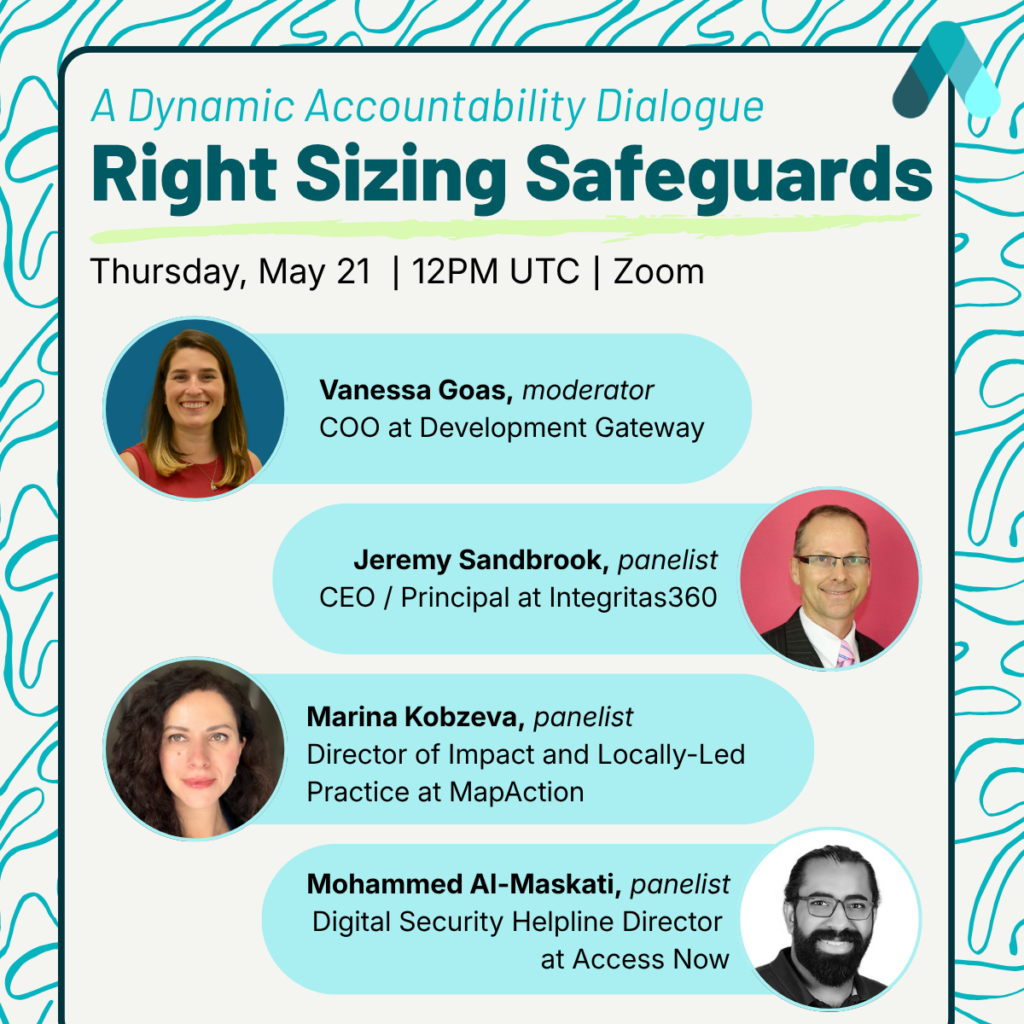
Special thanks to those who participated in the Dynamic Accountability Dialogue:
Moderator: Vanessa Goas, COO of Development Gateway
Panelists:
Accountable Now is committed to promoting a more just, equitable & accountable world. Do you have a story to share that demonstrates how organizations can strengthen their Dynamic Accountability practices?
45,000+ organizations operating in 180+ countries are using the Global Standard to guide their work and put people at the heart of their accountability measures. Now, the 10 cohosts are working to review and refresh the Standard to ensure its fit for the future too. If you work in or with civil society, and believe our accountability practice should center the people we work for and with, we want to hear from you.
Get Involved